Free Zone vs Mainland? The 2026 Decision Guide Every UAE Entrepreneur Needs
Introduction
Freezone vs mainland is the question that comes up in almost every first conversation with someone planning to set up a business in the UAE. Free zone or mainland?
It sounds like a simple choice. In practice, it shapes how you trade, who your customers can be, how much you pay, and how easily your business can grow. Get it right and the structure works quietly in the background while your business operates. Get it wrong and you might find yourself unable to take on the clients you actually want or paying for a setup that does more than you ever needed.
The freezone vs mainland decision is not about which one is better. It is about which one fits your business. This guide walks through exactly what separates them in 2026, so you can make that decision with confidence rather than guesswork.
The Core Difference, in Plain Terms
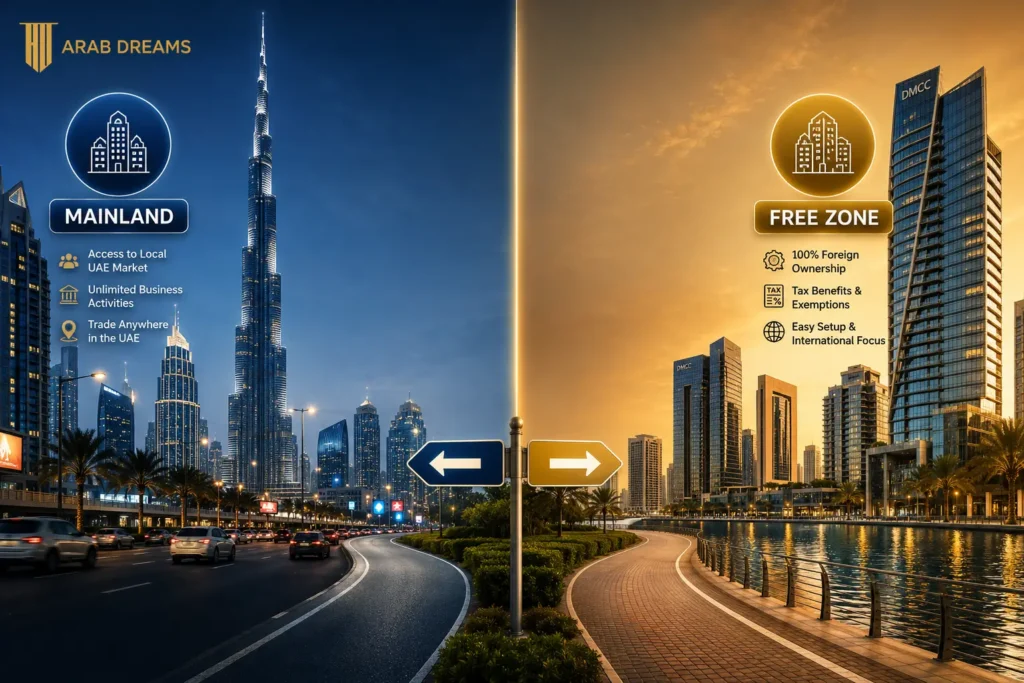
A mainland company is licensed by the relevant Department of Economic Development and can trade freely anywhere in the UAE, with no restriction on which clients you work with or where your office is located. It can also bid for government contracts, which freezone companies generally cannot.
A freezone company is registered within one of the UAE’s many designated economic zones (DMCC, JAFZA, IFZA, Dubai Silicon Oasis, and others), each governed by its own authority. These zones were built to attract foreign investment through full foreign ownership, tax benefits, and streamlined setup. The historic trade-off was restrictions on doing business directly with the mainland market without a distributor or local agent.
That trade-off has narrowed significantly. Reforms in recent years allow 100% foreign ownership for mainland companies in most sectors too, so the ownership advantage that once made freezones the obvious choice for foreign founders is no longer the deciding factor it used to be.
So what is the deciding factor now? Mostly, where your customers are and how your business actually operates day to day.
When Mainland Makes More Sense
If your business depends on direct, unrestricted access to the local UAE market, mainland is usually the better fit.
Retail businesses that need a shopfront accessible to walk-in customers anywhere in the city. Service businesses, consultancies, contractors, and agencies that need to invoice and work directly with clients based across Dubai or other emirates without restrictions. Any business that wants the option to bid for government or semi-government contracts, since this route is generally only open to mainland-licensed companies.
Mainland setup also tends to suit businesses planning to scale physically, opening multiple branches, hiring larger teams, or expanding their office footprint as they grow, since mainland licensing does not tie you to a specific zone’s facilities.
The freezone vs mainland comparison becomes clear when you consider that mainland companies enjoy unrestricted market access that freezones simply cannot match.
When Freezone Makes More Sense
Freezones tend to suit businesses where the core activity does not depend on direct UAE mainland trading.
Consultancies and service providers whose clients are mostly international. E-commerce businesses sell through online platforms rather than physical retail presence. Holding companies, media production, technology and software businesses, and import-export operations that primarily deal with goods moving through the freezone rather than into the local market.
Freezones also remain attractive for cost-conscious startups and solo founders. Setup packages are often more affordable, processing tends to be faster, and many zones offer flexible options like shared desks or virtual offices that reduce overhead significantly in the early stages.
If budget is the primary concern, the question of the cheapest freezone in the UAE comes up often, and the honest answer is that it depends on what is included in the package. Some zones advertise very low headline prices that cover only the license itself, with visas, office space, and other essentials priced separately. Others bundle more into the initial cost. Comparing the all-in cost, not just the headline number, is the only way to know which option is genuinely the cheapest freezone in UAE for your specific needs.
Popular options include DMCC (media and commodities), JAFZA (general trade), Dubai Silicon Oasis (technology), and IFZA (Abu Dhabi). Each has different pricing structures, visa allowances, and industry specializations.
What People Get Wrong About Freezone vs Mainland
The most common mistake is choosing based on what was easiest or cheapest to set up, without considering how the business will actually operate once running.
A consultancy that signs up with a freezone because it was the fastest option, then realizes six months later that half their clients are based in Dubai and want to be invoiced locally, is a situation that comes up regularly. Switching structures later is possible but adds cost and time that could have been avoided with the right setup from the start.
The opposite happens too. Businesses choose mainland because it sounds more “serious” or permanent, when their actual operations are entirely international and a freezone would have been faster, cheaper, and equally suitable.
Another frequent misunderstanding is assuming a freezone automatically means zero tax forever. Freezone companies can benefit from preferential corporate tax treatment, but only if they meet specific qualifying conditions and maintain them. This is not automatic and requires ongoing attention.
Questions Worth Asking Yourself First
Before deciding between freezone vs mainland, it helps to answer a few honest questions about how your business will actually function.
Where are most of your clients or customers based: inside the UAE or internationally? Do you need a physical retail location accessible to the public? Will you ever want to bid for government contracts? How many employees do you expect to have in the next two to three years, and where will they be based? Is your budget the primary constraint right now, or is long-term flexibility more important?
There are rarely perfectly clean answers to all of these. That is normal. The point of asking them is to identify which factors matter most for your specific business, because that is what should drive the decision between freezone vs mainland, not which option a friend chose or which one happens to be advertised most aggressively.
Freezone vs Mainland: Cost Comparison
Freezone Setup Costs:
- License fee: AED 2,000-5,000
- Office space (zone packages): AED 2,000-8,000/month
- Visa sponsorship: AED 500-1,500
- Professional services: AED 1,500-3,000
- Total startup: AED 4,000-10,000 (excluding office rent)
The cheapest freezone in UAE typically offers these lower costs because zones provide bundled packages and shared facilities. However, restrictions apply—you’re confined to zone operations and limited in mainland market access.
Mainland Setup Costs:
- License fee: AED 500-2,000
- Office space (market rental): AED 5,000-15,000/month
- Office registration: AED 100-500
- Visa sponsorship setup: AED 1,000-2,500
- Professional services: AED 3,000-8,000
- Total startup: AED 7,000-18,000 (excluding office rent)
Mainland costs are higher primarily due to commercial office space rental on the open market. However, you get unlimited market access and government contract eligibility.
Frequently Asked Questions
Q1: Is freezone vs mainland the right question to ask?
Yes. This decision determines your market access, growth potential, and operational restrictions for years. It’s the foundation of your business structure.
Q2: Can I switch from freezone to mainland later?
Yes, but it requires closing your freezone company and establishing a new mainland entity. This adds costs and delays. Choose correctly from the start.
Q3: What is the cheapest freezone in the UAE?
That depends on what’s included in the package. Compare all-in costs (license + office + visas) rather than just the headline price. JAFZA and some smaller zones tend to offer competitive pricing for startups.
Q4: Do freezones pay corporate tax?
Freezones offer preferential tax treatment, but this isn’t automatic and requires meeting specific conditions. It’s not zero tax forever—you need to maintain compliance.
Q5: Can my freezone company work with mainland clients?
Technically yes, but with restrictions. You typically need a local agent or distributor. Mainland companies have no such restrictions.
How Arab Dreams Approaches: The Freezone vs Mainland Decision
This freezone and mainland question is one of the first things discussed in any consultation at Arab Dreams, and deliberately so. It is the foundation everything else gets built on.
Rather than defaulting to whichever option is fastest to process, the conversation starts with understanding the business itself. What does it do? Who are the clients? What does growth look like over the next few years? And what does the budget realistically allow for right now versus later?
For clients where a freezone makes sense, Arab Dreams helps identify which zone actually fits best, since not all freezones are equal in cost, visa allowances, or industry focus. We focus on finding the cheapest freezone in UAE that matches your specific needs—not just the lowest headline price.
For clients where mainland makes more sense, the focus is on getting the right license category and structure in place from the start so the business is positioned to operate and grow without needing to restructure later.
Either way, the goal is the same. A setup that fits the business as it actually is and as it is likely to become, rather than one chosen on price or speed alone.
CONCLUSION
Whether a freezone or mainland is better depends entirely on where your business operates, who your clients are, and where you see things going over the next few years. The freezone vs mainland decision shapes your entire business structure, so it deserves careful consideration.
What matters most is making this decision deliberately, based on how your business actually works, rather than defaulting to whichever option seemed easiest to research first or seemed like the cheapest freezone in UAE at first glance.
If you are still weighing the freezone vs mainland decision, book a free consultation with Arab Dreams. We will walk through your business with you and give you a clear, honest recommendation on which structure genuinely fits, along with a realistic breakdown of costs either way.